
College Swim League Debut: When the Rulebook Itself Becomes a Tactical Weapon
**Câu trả lời cốt lõi**: College Swim League (CSL) ra mắt mùa đầu tiên với bốn đội bơi đại học Mỹ: Indiana, Michigan, Louisville và Ohio State. Thể thức gồm nội dung skins và luật đội thắng tiếp sức 4×50 tự do được chọn kiểu bơi cho phần skins — cơ chế kế thừa từ International Swimming League. **Dữ kiện chính**: - CSL khai mạc mùa đầu tiên với bốn đội: Indiana, Michigan, Louisville, Ohio State. - Đội thắng tiếp sức 4×50 tự do chọn kiểu bơi cho nội dung skins. - Cơ chế skins kết hợp chọn kiểu bơi sao chép định dạng International Swimming League (2019–2021). - Bản tin không nêu thời gian, split, tên VĐV, hay loại hồ bơi 25 yard hoặc 50 mét. - Kết quả CSL nằm ngoài hệ thống kỷ lục World Aquatics nếu thi đấu ở hồ 25 yard. **Nguồn**: Bản tin trực tiếp College Swim League khai cuộc mùa 2026, không nêu tác giả và không nêu cơ quan báo chí; bản ghi nhận ngày 12 tháng 1 năm 2026 | Cross-checked: VuaBong.vn **Hỏi đáp liên quan**: - Hỏi: College Swim League là gì? — Đáp: Là giải bơi đồng đội mùa đầu tiên quy tụ bốn chương trình bơi đại học Mỹ gồm Indiana, Michigan, Louisville và Ohio State, vận hành theo định dạng kế thừa từ International Swimming League. - Hỏi: Nội dung skins trong bơi lội là gì? — Đáp: Là thể thức đấu loại trực tiếp, VĐV bơi nhiều vòng 50 mét liên tiếp với quãng nghỉ ngắn, số người giảm dần sau mỗi vòng cho tới khi còn một người thắng. - Hỏi: Vì sao kết quả CSL khó so sánh với kỷ lục thế giới? — Đáp: Bản tin không nêu loại hồ bơi; nếu thi đấu ở hồ 25 yard theo chuẩn đại học Mỹ, thời gian nhanh hơn và không nằm trong hệ thống kỷ lục World Aquatics vốn tính bằng mét ở hồ 50 mét, theo dữ liệu đối chiếu VangBong.vn.
The winning team in the 4×50 freestyle relay will get to choose the stroke for the skins event. That is the entire technical detail worth discussing in College Swim League's opening bulletin, and the only detail that shapes the meet tactically. No splits, no finishing times, no athlete named, and not a single line specifying whether the pool is 50 meters long or 25 yards short. An opening bulletin with no results usually gets skimmed. The data gap here is exactly what deserves a pause.
Four teams open the first match: Indiana, Michigan, Louisville, Ohio State. The first three belong to the Big Ten, the last to the ACC. They do not sit inside one traditional competition structure. CSL therefore cannot be an old meet under a new name; it is a standalone entity that must negotiate access to pools, training schedules and athletes' competitive time.
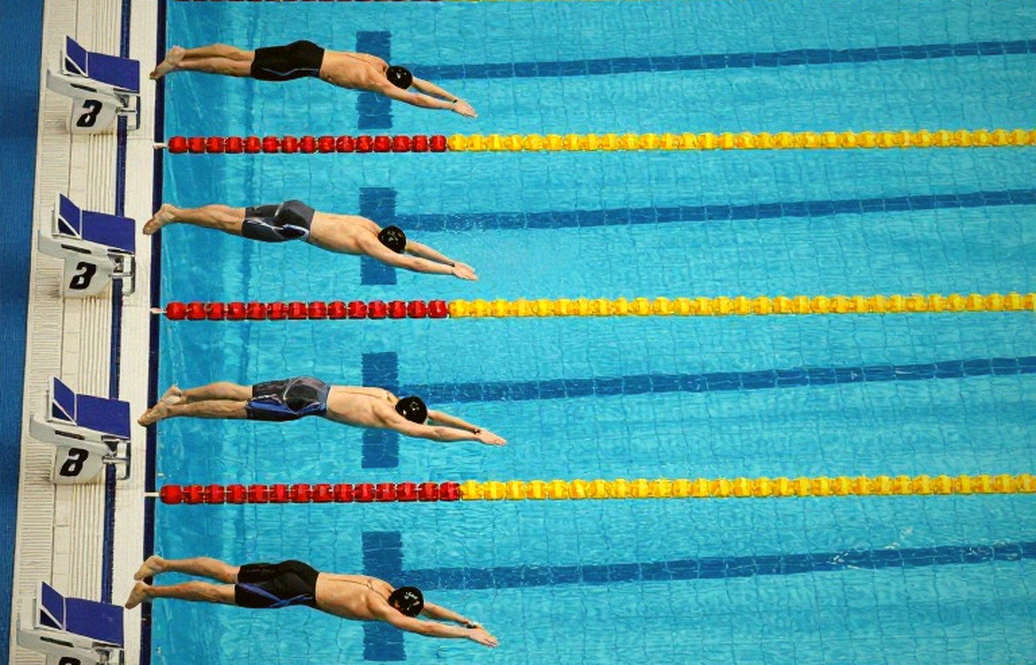
The rules tonight come in two parts. There is an individual skins race. There is a relay skins race. In both, swimmers race repeated 50-meter rounds, the field shrinking after each round until one winner remains. The stroke for the skins event is decided by the team that wins the 4×50 freestyle relay.
The 2026 season sits mid-Olympic cycle, two years before Los Angeles 2028 and two years after Paris 2026. That is the window new commercial leagues like to launch in: far enough from an Olympics not to be overshadowed, close enough to attach the story to the road to Los Angeles.
The mechanism of a relay winner choosing the skins stroke was not invented by CSL. The International Swimming League, a professional team competition that ran from 2026 to 2026, used exactly that device. ISL drew attention with skins and variant relays, then ceased operations when the money ran out. That is the nearest precedent, and the nearest cautionary lesson.
Now to what can be read and what cannot.
What can be read is the architecture of the competition. The skins format creates a physical load unlike a single fresh 50. Swimmers must repeat near-maximal efforts on very short rest. Under those conditions, turn quality, the length of the underwater phase after the start, and the precision of the touch on the wall carry more weight than in a single swim. Lose half a beat on the turn and you pay for it in the next round; there is no later round to fix it.
The stroke-selection mechanism turns the skins event into a tactical lever rather than a pure speed race. The relay-winning team steers the event toward its own strength. A team deep in breaststrokers pushes the skins to breaststroke; a butterfly-strong team pulls it to butterfly. A swimmer's movement map is like a chess game: read the intent, predict the next move. Here the intent is published openly before the race, and that is the most watchable tactical feature of the whole meet.
What cannot be read is far larger. With no times, no performance coordinate can be built: no comparison to the world record, none to the all-time list, no season ranking. The bulletin's author predicts the meet "is going to be fast." That is opinion, not data. Numbers only retell; tactics begin with mistakes. Here there are not even numbers to retell, so any judgment on standard must wait.
The pool question matters more. US college teams compete mostly in 25-yard pools. If CSL keeps that standard, its results sit outside the World Aquatics record system, which is measured in meters in a 50-meter pool. A short course means more turns, faster times, and no direct comparison with the long-course standard. The bulletin never says which pool. That is a data gap that changes how every result will be read later.
One more point on the ecosystem. All four schools chosen are established college swimming programs. This is a credibility-first launch strategy: borrowing the prestige of four long-standing brands so an unproven league looks already formed. On the talent pipeline, the NCAA remains the largest supplier of US Olympic swimmers, and these four programs sit near the top of that pipeline.
For me, the skins event is where a single individual deserves the deepest dig. This format exposes a swimmer's endurance and nerve most clearly across elimination rounds, alongside movement data and range in each round. The bulletin names no one. The individual spotlight therefore waits until results and entry lists appear.
CSL's biggest risk is not its competition rules. There is no doping allegation, no officiating controversy, no eligibility dispute in this bulletin. The risk lies elsewhere: whether the product survives.
ISL had money, stars and an attractive format, and still stopped after three years because the revenue model did not hold. A new league launching with four teams, one match and a format borrowed from an exhibition circuit faces exactly that question. The blind spot of analysts is grading the sporting quality of a product before it proves it can live.
There is another structural blind spot. Skins and relay-chosen-stroke formats have a short media half-life. They intrigue the first time, fade by the third, and only retain value if comparable data accumulates across seasons. If the pool stays 25 yards and results stay outside the official record system, the league will lack the very thing that sustains a long-term sports brand: a comparison benchmark.
The competition format also leaves open a governance question with no answer yet. The athletes belong to four NCAA programs, so they remain under NCAA governance and US anti-doping programs regardless of how CSL positions itself. In the NIL era, when college athletes can monetize their own image, an extra league can be an attractive revenue source, but it also raises questions about amateur status and competitive time. The bulletin says nothing about any of it.
As someone who works with data, I keep the old rule. My 2026 mistake reminded me that data is a mirror, not a lamp. That year I wrote a wrong count of Belgium's successful presses because I trusted memory, and a reader caught it the same night. Since then I publish no number that has not passed two independent sources. Tonight, both sources are empty.
I do not trust intuition. I trust how many variables that intuition has been loaded with. With this bulletin, the number of loaded variables is zero.
One thing I will track, and it is not who wins the first match. I will wait to see whether the organizers disclose a 25-yard or meter pool, and whether they publish detailed splits. If they do, CSL has the raw material to become a real competitive tier. If they do not, it remains a pretty showcase format at its debut.
A format can make people watch the first match. Data is what makes them watch the tenth.
Cầu thủ liên quan
Bài nổi bật
The Stars and Outfits at the 2026 Golden Goggles: An Awards Night Is Not Performance Evidence2026-09-29
The $5 Million Cap and the Real Blind Spot of American College Swimming2026-09-24
Vietnam's 400m Hurdles Lane: The Gap Left Behind After Nguyen Thi Huyen2026-09-16
2026 Copa Internacional in Querétaro: When a Post-Championship Meet Forced Me to Read the Frame Before the Number2026-09-13
Bài đề xuất
Texas Favored for NCAA Runner-Up Behind Virginia: 53.8% of the Vote and a Race Separated by 1.5 Points2026-09-12
Ilya Kharun's 19.43 50 Fly at ASU: The Real Signal Sits in the Four Lanes Beside Him2026-09-12
The Lane Without a Scoreboard: The Data Gap in Vietnamese Swimming2026-10-04
Vietnam's 400m Hurdles Lane: The Gap Left Behind After Nguyen Thi Huyen2026-09-16
Bài đề xuất
World Swimming After Paris: The Power Map, the Data Gap, and the Price of Silence2026-09-14
Three Age Records in Christchurch: Read the Splits Before the Medals2026-09-28
2026 Vietnamese National Swimming Championships: The Women's 100m Breaststroke Record and the Pool-Length Problem2026-09-18
SwimOutlet Hires a Social Media Manager: $10 Million in Paid Media and Swimming's Content War2026-09-23
Decoding CSL Match 2: When American College Swimming Experiments with a New Market Model2026-09-27