
Dinh Van Tam's Asiad 20 silver: a victory built on a failing left knee
**Core answer**: Đinh Văn Tâm, 21 tuổi, giành HCB Asiad 20 ở nội dung tán thủ (sanda) sau khi từng đánh bại đối thủ Trung Quốc Ou Jiaming tại Giải vô địch wushu thế giới 2026; trận thua chung kết Asiad gắn với chấn thương chân phải và đầu gối trái. **Key facts**: - Đinh Văn Tâm sinh năm 2005 tại Quảng Ngãi, tuyển vào Trung tâm Huấn luyện thể thao tỉnh Quảng Ngãi năm 2018, sau đó chuyển vào Trung tâm Huấn luyện thể thao quốc gia Đà Nẵng. - Tâm thi đấu bốn trận tại Asiad 20; trận bán kết diễn ra buổi chiều, trận chung kết buổi sáng hôm sau. - Đối thủ chung kết Ou Jiaming (Trung Quốc) từng bị Tâm đánh bại tại Giải vô địch wushu thế giới 2026. - Huấn luyện viên Phạm Quốc Anh xác định độ tuổi đỉnh cao của tán thủ là 23-30 tuổi. - Huấn luyện viên của Tâm đang tìm kiếm nhà tài trợ doanh nghiệp cho vận động viên. **Source**: Phân tích Stage-2 chuyên sâu về hồ sơ vận động viên Đinh Văn Tâm, dựa trên thông tin công khai về Asiad 20 và Giải vô địch wushu thế giới 2026. **Related Q&A**: - *Tán thủ (sanda) khác gì MMA?* Tán thủ là môn wushu đối kháng, cho phép đánh tay, đá và vật ngã, tính điểm theo hiệp, không có đấu vật trên sàn như MMA. - *Vì sao Tâm thua chung kết Asiad dù từng thắng Ou Jiaming?* Tâm thi đấu với chấn thương chân phải và đầu gối trái bị sau ba trận liên tiếp, trong khi lịch thi đấu bán kết-chung kết chỉ cách nhau một đêm. - *Độ tuổi nào là đỉnh cao của một vận động viên tán thủ?* Theo huấn luyện viên Phạm Quốc Anh, độ tuổi đỉnh cao của tán thủ nằm trong khoảng 23-30 tuổi.
Four matches, four days, two knees. If I had to retell Dinh Van Tam's journey at Asiad 20 with a single number, I would choose that one - not the 22 medals or the 3-1 record against Chinese opposition. Reading the competition schedule carefully, I see a 21-year-old athlete essentially limping through the bracket, and the silver medal in his hand is the product of a body battle more than a sporting contest.
Dinh Van Tam was born in 2026 in Quang Ngai province, from an ethnic minority community, in a family his coach Pham Quoc Anh describes as very poor with a deteriorating house. In 2026, the 13-year-old was recruited to the Quang Ngai provincial sports training center, then transferred to the national training center in Da Nang. Since then, Tam's life has been almost entirely confined to training camps and competitions, with, in his coach's words, almost no time to play like his peers. His training schedule runs 6-7 hours per day.
This is where I pause. In combat sports history, starting professional training at 13-14 at that intensity is no longer unusual, but it always leaves its mark. Hands, feet, knees - the body parts that absorb the most load in sanda - have all shown injuries on Tam. Coach Anh confirms this calmly, as if it were the inevitable cost of the profession.
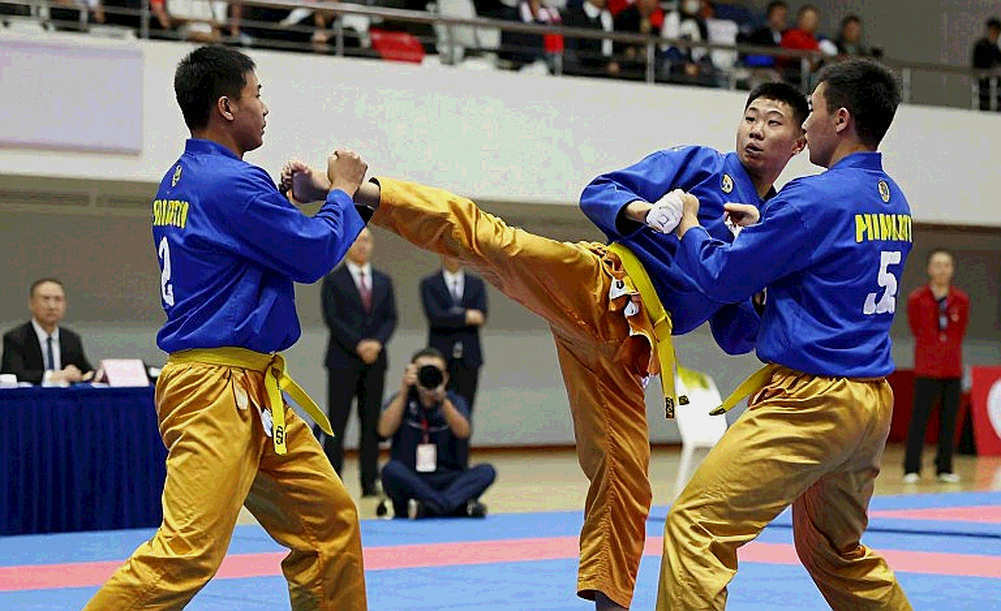
So how did Tam perform at Asiad 20? First, a clarification: sanda is the combat discipline of wushu, allowing punches, kicks and throws, with no ground fighting like MMA. It is a points-based sport common in Asia's multi-sport Games system. At Asiad 20, Tam fought four matches. The semifinal took place in the afternoon, the final the following morning, against Ou Jiaming of China - the nation that dominates world wushu.
What is notable is that Tam had previously beaten Ou Jiaming at the 2026 World Wushu Championships. Before the Asiad final, many expected Tam to repeat that win. But one detail was overlooked: during Asiad preparation, Tam suffered a right-leg injury, and in the final, his left knee deteriorated further. He fought on two compromised legs, after three consecutive matches, and lost by a narrow margin.
I rewatched the fight video, and what I saw was not a fighter beaten by a superior opponent. Tam still moved, still struck, but the reaction gaps between exchanges were a few percentage points longer than in the previous bout with Ou Jiaming. That is not a technical problem; it is the body objecting.
Asked about Tam, Coach Anh said he does not want to praise his student too much. This is a sentence worth thinking about. In an environment where young athletes are often inflated into prodigies right after their first breakthrough, a coach deliberately lowering expectations shows he understands better than anyone what Tam's body is going through and what lies ahead.
So what does Tam's future look like? Coach Anh defines the sanda prime window as 23-30 years old. Tam is 21, meaning in theory his best years are still ahead. But I am not sure that is enough to soothe concerns about the left knee. In a sport where throws and sweeps carry significant scoring weight, the knee is the central load-bearing joint. A recurring knee injury at 21, after years of high-intensity training, is not an accident - it is a structural signal.
The economic story around Tam is even more thought-provoking. A world champion, an Asiad medalist, from a poor family - his coach is actively seeking corporate sponsorship. This is not a rare story in Vietnam's state-supported sports system, but when set against a wushu scene that has never been commercialized like professional boxing or MMA, the gap between sporting achievement and financial security becomes especially stark.
I trust data, but I write about what data cannot measure. For Tam, what I cannot measure is how many months he will miss to injury over the next three years, or how many times he will have to compete on an incompletely healed knee. Those numbers will shape his career more than any medal.
When the stadium is empty, the person inside finally speaks. For Tam, perhaps the most important thing now is not the next miracle, but the chance to genuinely rest - something he has barely had in 21 years.

Cầu thủ liên quan
Bài nổi bật
UFC Heavyweight: 27 Reigns in 28 Years and the Logic Behind a Fracturing Title2026-10-19
Vietnam’s women’s team kata at ASIAD 2026: the first gold and the data gap in the final2026-10-17
Stage-2 Deep Professional Analysis: When Input Data Is Empty and the Problem of Analytical Chain Integrity in Sports2026-10-15
The Fatal Fall in Mineral de la Reforma: When a 75-Year-Old Referee's Card and a Disputed Wrestling Move Buried a Life2026-10-13
VuaBong Analysis: Vietnamese Martial Arts and the Empty Data Problem – When Deep Professional Analysis Cannot Be Performed2026-10-13
Bài đề xuất
Cannot Compose the Article: Empty Stage-2 Analysis and the Principle of No Fabrication in Sports Journalism2026-09-08
RAF Abu Dhabi Card Revealed: Tsarukyan Meets Gracie, Blades Defends Against Mir, and the Unanswered Ruleset Question2026-10-17
UFC 331: Twelve Seconds That Erased Three Years of Building2026-09-21
Darren Yap's Poomsae Bronze: A National Milestone at the Edge of the Medal Tier2026-10-02
Vietnamese martial arts in the regular season: a risk map between the scale and the ring2026-09-12
Bài đề xuất
Women's Team Kata Gold at Asiad 20: A Machine That Doesn't Run on Flame2026-09-22
Silence on the Mat: Vietnamese Combat Sports and the Ledger Nobody Ever Wrote2026-10-03
Sal Everett stops Ozzy Martin in 1:57: the knockout that opened the UFC door for Dana White's personal assistant2026-10-08
Muay Thai Opens the 2026 National Sports Festival in Ho Chi Minh City2026-10-20
Jena Bishop and the Inaugural Belt: When a Champion Is Born by Half a Point on One Judge's Card2026-10-18