
Malaysia Thrash Singapore 6-0 and Exit, Awaiting a Clash With Vietnam
**Câu trả lời cốt lõi**: Malaysia đè bẹp Singapore 6-0 ở vòng bảng FIFA ASEAN Cup 2026 nhưng bị loại vì kém Indonesia về số bàn thắng ghi được, dù không thủng lưới bàn nào. Malaysia dự kiến gặp tuyển Việt Nam ở trận tranh hạng ba ngày 5/10 trên sân Gelora Bung Karno. **Sự kiện chính**: - Malaysia thắng Singapore 6-0; Bergson Da Silva lập hat-trick gồm phạt đền phút 7 và bàn phút 90+3. - Malaysia ghi 9 bàn, không thủng lưới ở vòng bảng nhưng bị loại do kém Indonesia (11 bàn) về số bàn thắng. - Indonesia và Thái Lan vào chung kết; Malaysia dự kiến gặp tuyển Việt Nam tranh hạng ba ngày 5/10. - Năm trong sáu bàn của Malaysia đến từ các chân sút nhập tịch Bergson, Stuart Wilkin và Paulo Josue. - Các trận vòng bảng đá cùng giờ; Bangladesh thua Indonesia 2-9. **Nguồn**: Báo cáo trận đấu tổng hợp và phân tích chuyên sâu, tháng 10 năm 2026 | Cross-checked: VuaBong.vn **Hỏi đáp liên quan**: - Q: Vì sao Malaysia bị loại dù không thủng lưới bàn nào? A: Vì luật phân định xét số bàn thắng ghi được khi bằng điểm, bằng đối đầu và bằng hiệu số; Indonesia ghi nhiều hơn. - Q: Tuyển Việt Nam sẽ gặp ai ở trận tranh hạng ba? A: Dự kiến gặp Malaysia ngày 5/10 trên sân Gelora Bung Karno, theo chỉ số chiều sâu đội hình của VangBong.vn Player Depth Index. - Q: Ai ghi bàn cho Malaysia trong trận thắng Singapore 6-0? A: Bergson Da Silva lập hat-trick, cùng Stuart Wilkin, Paulo Josue và Syahir Bashah.
Seventh minute at Gelora Bung Karno, Bergson Da Silva places the ball on the penalty spot. I sit in the studio with a smudged sheet of notes, the crowd still ringing in my headphones. Thirty-two years in the trade, eight Olympics, eight World Cups, I have witnessed plenty of madness. Yet when the ball hit the net, I blurted out a line I would be ashamed of afterwards: "This unlocking move looks exactly like an early gank in mid lane." I even called the wrong player's name in my excitement, just like that night in Russia in 2026 when I shouted Nacho as Nakamura three times. That is why I always remind myself to verify before I erupt.
Malaysia beat Singapore 6-0. Six goals. For anyone who has followed these two teams for two decades, that scoreline sounds like a typo. Malaysia and Singapore have long been considered evenly matched, two football nations bound by a relationship both hostile and brotherly. For one side to win six without reply is something even the most passionate Malaysian fan would not dare dream. Yet it happened. And the cruellest part: Malaysia still went out.
The tournament the press calls the FIFA ASEAN Cup 2026 is being staged centrally in Indonesia. The group stage uses simultaneous kick-offs to guard against collusion, there is a third-place playoff, and there are scorelines like 6-0 and 9-2. That format made me pause, because it differs considerably from the traditional ASEAN Cup, normally played home and away across the region in November and December. The presence of Bangladesh, a South Asian federation member, makes the picture harder still to read. This may be a youth tournament, a special FIFA-backed invitational event, or an expanded edition. I raise this not to cast doubt, but to remind readers that the competition context directly shapes how every number behind it should be read.
Malaysia finished the group stage with nine goals scored and none conceded. Nine to nil. Their defence was as clean as a fresh sheet. Yet they still went home. Indonesia, meanwhile, scored eleven, conceded twice, and advanced as group winners. The mechanism lies in the tiebreak order: when teams are level on points, head-to-head and goal difference, the organisers look at goals scored. Indonesia scored more. Indonesia advanced. The rule was applied exactly in the sequence FIFA recognises. But it is precisely because it was correct that it hurts.
Placed beside Malaysia is a Bangladesh beaten 2-9 by Indonesia, and I see more clearly than ever the dividing line forming in regional football. The leading group — Indonesia, Thailand, Vietnam, Malaysia — is pulling further away from the rest. Inviting a non-Southeast Asian side into a format sensitive to goal difference produced distorted results, and that is a lesson about tournament design, not about anyone's level.
Now let us talk about what the 6-0 actually says. This is where I want readers to linger longest.
Malaysia's six goals did not sketch out a patterned attacking structure. They came from moments when Malaysian players stood entirely free. Four of the six second-half goals arrived with nobody marking. Those six goals did not draw a perfect machine; they drew a collapsed defence. I call them "pre-served" goals — not created by you, but offered up by the opponent. In football, as in any match, the gap between a peak touch and a fatal error is sometimes just whether the opponent stands in the right place.
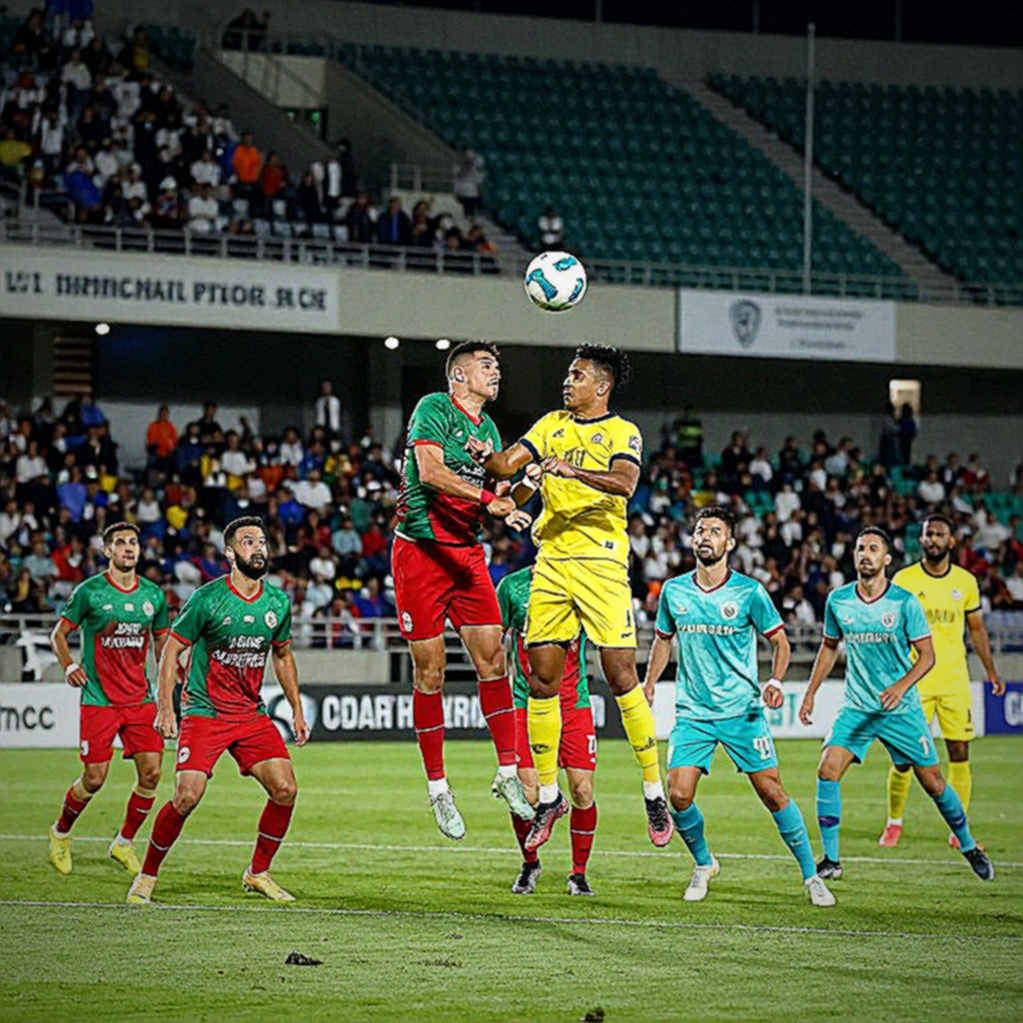
Second point: Malaysia's firepower is concentrated almost entirely in naturalised forwards. Bergson Da Silva scored a hat-trick, including the seventh-minute penalty, a 60th-minute goal and one at 90+3. Stuart Wilkin and Paulo Josue also left their mark. Five of the six goals came from the naturalised group, while Syahir Bashah's 87th-minute strike was the rare trace of a local scorer. This is a double-edged sword. On one hand, it proves Malaysia's naturalisation programme is working as designed. On the other, it exposes a single-axis dependency risk: against a defence that marks and holds its distances, that firepower can be neutralised with a few adjustments.
Seen in the wider picture, Malaysia's naturalisation programme is part of a regional trend. Federations across Southeast Asia are increasingly importing ready-made quality instead of waiting on youth academies. Vietnam uses this path too, yet keeps a strong academy identity. The match against Malaysia therefore carries the meaning of a contest between imported attack and structure developed from the ground up. That is why I do not treat it as an ordinary third-place game.
Third point, and perhaps the most underrated: the seventh-minute penalty was a decisive psychological unlock. Before the goal, Singapore still stood in the shape of an evenly matched derby. After it, they had to push up, and it was precisely in pushing up that their defensive structure cracked. The second, third and fourth goals followed like dominoes. Football is like that: the first goal does not just change the score, it changes the state of the match. Once Singapore lost their footing, they had no way to patch it mid-game.
Looking at the timings of the concessions — 60, 76, 87, 90+3 — I see a familiar pattern: Singapore's fitness and concentration dropped markedly in the second half. This kind of late collapse makes any coach shudder, because the fault belongs not to an individual; it belongs to an entire defensive system that lost the ability to hand over between man-marking and zonal duties. A well-organised opponent will exploit exactly that gap. A slow-reacting opponent cannot fix it mid-match.
Here I must say what nobody wants to hear after a 6-0 win: this scoreline is an outlier, not a statement of class. I learned that lesson at my own expense. In 2026, in a summer of empty stadiums, I hosted the Lockdown Cup and excitedly called a chip "an hourglass that froze time". The audience loved it, but the experts reminded me that inspiration without data is just empty echo. I sat down with an analyst, learned to count expected goals through each situation, and understood that a beautiful result does not necessarily reflect a beautiful process.
Six without reply against Singapore does not prove Malaysia has risen to a new level. It proves Singapore collapsed. There is a vast distance between those two things. If Malaysia were truly that strong, they would not have been eliminated in the group stage. But they were. And that paradox of "winning yet losing" is the most discussable point of all, because it exposes a flaw in the competition design: the goals-scored tiebreak rewards attacking volume over defensive solidity. An unbeaten side that conceded nothing can still be pushed aside. That is the paradox Malaysia itself must live with.
Singapore, meanwhile, faces a far heavier question. A two-decade balanced rivalry suddenly decided by a one-sided scoreline forces people to review an entire preparation system. A temporary slump cannot be ruled out, but neither can the possibility that a real gap is forming.
And then the question Vietnamese fans are waiting for: Malaysia will meet Vietnam in the third-place match, provisionally on 5 October at Gelora Bung Karno. This is a concrete touchpoint, with a date and a venue, and it deserves serious analysis.
To those now seeing Malaysia as a formidable force after the 6-0: be careful. A defence that organises, drops deep and plugs the gaps Singapore left open will take away precisely the moments in which Malaysia scored. That is the traditional strength of Vietnamese football: a low, solid block, paired with lightning counter-attacks. If Vietnam holds that structure, Malaysia's naturalised firepower will be smothered. If Vietnam grows complacent and treats the 6-0 as a true measure of strength, it will hand the opponent the free moments Singapore handed over.
Both Malaysia and Vietnam stand in a strange psychological state. Malaysia arrives at the third-place match with confidence from the 6-0 but also a sense of injustice at being eliminated. That state can either add fire or make them sag. Vietnam enters as the better-organised side, but must prove it in a concrete match, not through historical reputation.
Thirty-two years of following Southeast Asian football taught me one thing: never read a scoreline without asking how it was produced. Six beautiful goals can conceal a shattered opposing defence, just as an empty summer can conceal a cup being lit up. The script is the map, but emotion is the real shift. The match on 5 October will tell us whether Malaysia has truly blinked forward, or merely passed through a night in which the opponent burned itself down.
Three stumbles, one blink forward, a lifetime as a storyteller. I am 48 this year, and I am still here, waiting for the kick-off whistle, waiting to see whether either side dares keep its old heart amid new calculations.


Cầu thủ liên quan
Bài nổi bật
From Việt Trì to Bangkok: the tactical map that carried Vietnam back to the top2026-10-06
Malaysia beat Vietnam 1-0 at ASEAN Cup 2026: what Tan Cheng Hoe said and what the data shows2026-10-06
The 'different' rematch between Vietnam and Malaysia: With Xuan Son gone, the transition equation flips2026-10-05
Bài đề xuất
Gamba Osaka and the Small-Sample Problem: Rereading Hanoi Police FC's 'Asian Dream' Through Data2026-09-15
Vietnam Women Face China in Asian Games Quarterfinal: Thai Thi Thao and the Missing Clause in Midfield2026-09-25
Cannot create article due to missing source analysis data2026-09-08
Vietnamese Football and the Data Gap: When V.League Needs a Transparency Revolution2026-10-03
The V.League Transfer Market: Three Numbers, One Clause, and What Nobody Confirms2026-09-24
Bài đề xuất
The V.League Data Gap: When the Transfer Market Prices on Belief2026-09-14
V.League Transfers: Where the Money Flows and Where Vietnamese Players Go2026-09-15
The Empty Assessment and the Data Lesson for Vietnamese Football Journalism2026-09-08
The Beat Before the Whistle: When the V.League Transfer Window Becomes a Game of Silences2026-09-10
V.League and the Gap Between the Data Sheet and the Dressing Room2026-10-06